
Every engineering team says they're "using AI" these days. Fewer can point to an actual process that changed because of it. At ReifyCore, we rebuilt ours — and we did it around a methodology called AI-DLC (AI-Driven Development Lifecycle). Here's what that actually looks like in practice, not just in theory.
First, a problem most teams don't admit to
Copilot, Claude Code, Cursor — these tools genuinely make individual developers faster. We use all three, plus Visual Studio for the heavier lifting. But here's the thing nobody talks about: making one developer 30% faster at typing code doesn't make your team 30% faster at shipping software. The bottleneck was never typing speed. It's everything around the code — requirements that are vague until week three, architecture decisions made in a Slack thread, testing bolted on at the end, review cycles that drag because nobody's quite sure what "done" means.
Traditional SDLC — Requirements, Design, Build, Test, Deploy, Maintain — was built for a world where a human does every one of those steps by hand, in sequence, mostly alone. AI tools got dropped into that structure without changing the structure itself. That's the ceiling most teams are hitting.
What AI-DLC actually changes
This is the part that's easy to say and hard to do: AI-DLC doesn't bolt AI onto the old lifecycle — it treats AI as an actual participant in the lifecycle, from the very first requirement to the last deployment. The difference isn't cosmetic. A few concrete contrasts:
How we actually built this
We didn't just adopt a philosophy — we built a plugin that runs the whole thing end to end, and it starts with a person, not a prompt.
An SME writes the initial requirements. That's still deeply human — nobody wants an AI guessing at business intent from scratch. Those requirements go into structured markdown files, and from there our AI plugin takes over the first pass: enhancing, enriching, and clarifying the spec — flagging gaps, tightening ambiguous language, surfacing edge cases someone might not have thought to write down. This is what we mean by spec-driven development — the spec isn't a Word doc that gets skimmed once. It's the thing the whole build actually runs on.
Before anything gets built, there's a governance checkpoint — a real human-in-the-loop step where someone signs off on the clarified spec. This is non-negotiable for us. AI can draft and refine a spec faster than any team of humans, but deciding whether it's right stays a human call.
Once that's approved, the work gets divided into goals, and a team of agentic developers picks those up — building, running unit and integration tests, and iterating — all guided by an architecture and design framework the plugin itself enforces. That last part matters more than it sounds: without a consistent framework guiding it, you get agents making inconsistent architectural choices goal by goal, which turns into a maintenance headache six months later. The framework keeps everything coherent even as multiple agents work in parallel.
Only after tests pass does anything move toward deployment.
What we're seeing
Since putting this in place, the gains have shown up in three places:
- Time — because the spec is solid before building starts, we're not losing weeks to mid-build requirement changes.
- Cost — less rework, because ambiguity gets caught at the spec stage instead of the QA stage, which is a much cheaper place to catch it.
- Quality — testing isn't an afterthought bolted onto the end; it's baked into how each goal gets marked done.
Where this goes next
We're still early, and AI-DLC as a methodology is still young industry-wide. But the direction is clear: teams that restructure how software gets built — not just what tools developers reach for — are the ones who'll keep compounding gains in speed, cost, and quality at the same time. That's historically been a tradeoff. It doesn't have to stay one.
In traditional SDLC, requirements are a document someone writes and everyone interprets slightly differently. In AI-DLC, requirements become a living, structured spec that gets clarified and enriched before anyone writes a line of code — so ambiguity gets caught in hours, not sprints.
Traditional SDLC is a relay race — design finishes, then build starts, then test starts. AI-DLC compresses this because planning, scaffolding, and early testing can genuinely happen in parallel once the spec is solid.
Instead of a single engineer working a ticket top to bottom, work gets broken into goals that multiple AI agents can execute against — with humans reviewing output, not writing every line.
Unit and integration tests aren't a phase you get to if there's time — they're part of how each goal gets marked complete.
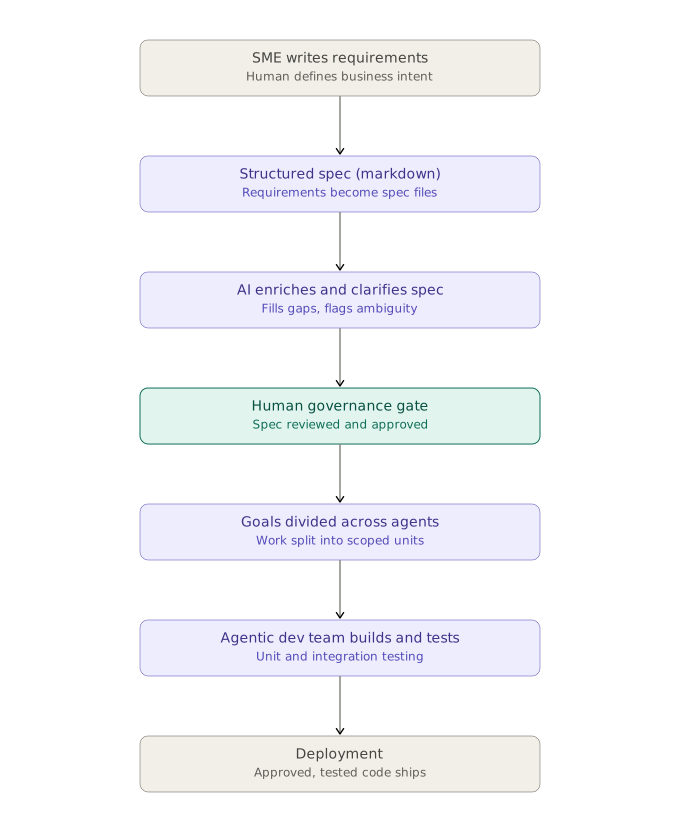
ReifyCore's AI-DLC workflow
What we'd tell any team trying this
Don't skip the human governance step. It's tempting to let the whole pipeline run without a checkpoint. Don't. The spec-approval gate is what makes engineers actually trust — and adopt — the process.
Spec quality is everything. If your spec is vague, agentic developers will build the wrong thing quickly instead of the right thing slowly. Invest there first.
Give agents a framework, not just a task. Without shared architectural guardrails, parallel agent work turns into inconsistent code fast.
This is a process change, not a tool change. Swapping in Copilot or Claude Code without restructuring how work flows around them gets you incremental gains at best.
That's the bet we've made at ReifyCore. So far, it's working.